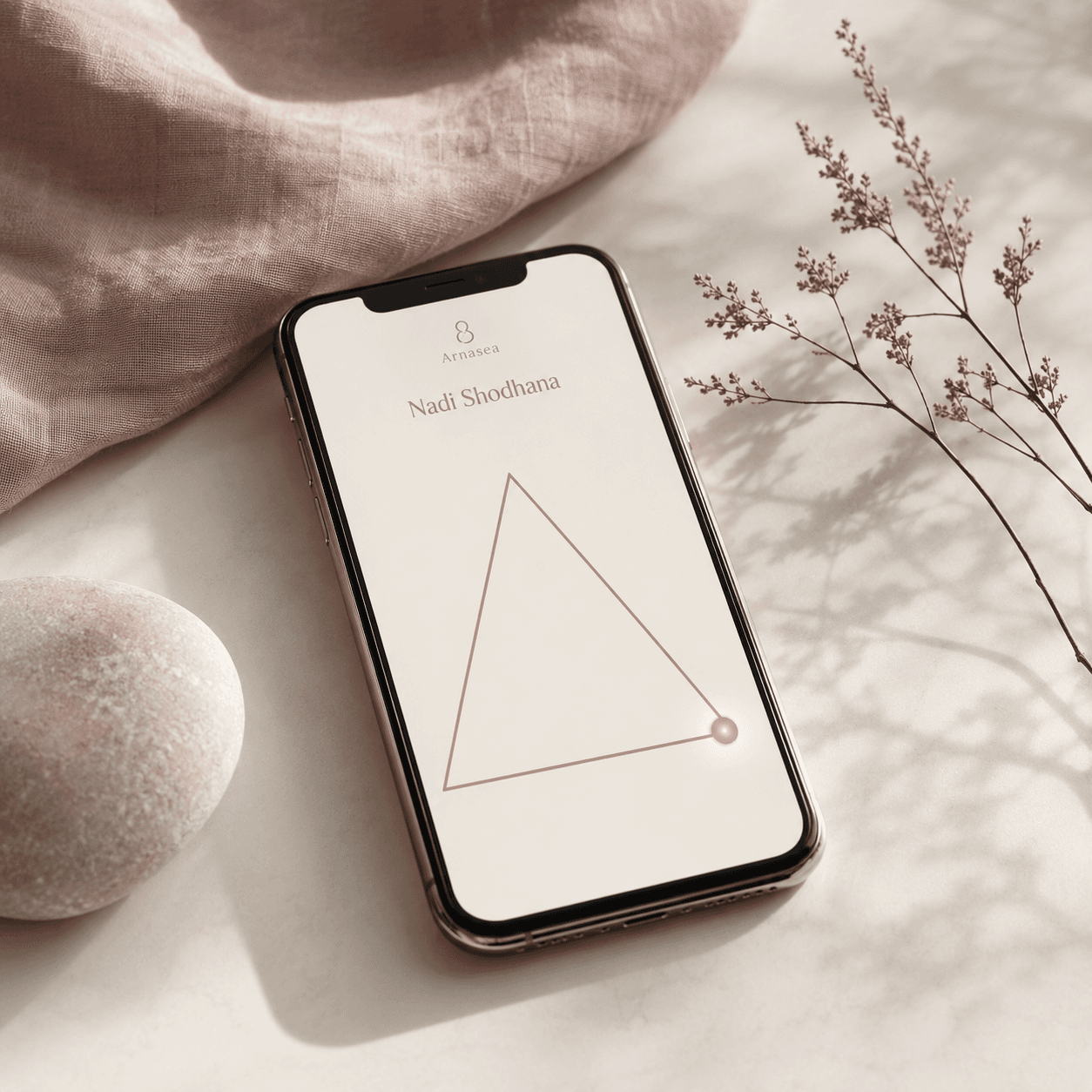
Nadi Shodhana, often translated as “alternate-nostril breathing” or “channel cleansing,” is one of the oldest breathing techniques in yoga. The principle is disarmingly simple: you inhale through one nostril, exhale through the other, then switch. And yet its effect on calm and mental clarity is among the most reliable there is.
It’s ideal when the mind is looping, before a decision, or simply to take a real pause in the middle of the day. Here’s where it comes from, what it does, and how to practise it well.
What is Nadi Shodhana?
The name is Sanskrit: nadi refers to the body’s energy channels in the yogic tradition, and shodhana means “cleansing.” The technique belongs to the pranayama, the breath-control exercises that have accompanied yoga postures for centuries. You’ll also see it called anuloma viloma.
In practice, you use your hand to close one nostril at a time, alternating sides with each phase. The traditional idea is to balance the two “currents” of the breath (left and right), associated in yoga with calm and energy. Beyond the symbolism, what matters for us is the observable effect: a clear slowing of the mind.
What does the research say?
Alternate-nostril breathing has been the subject of several studies in physiology and psychology. The most reproducible findings point to an activation of the parasympathetic nervous system, the one that brakes stress and brings the body back to calm.
- Lower heart rate and blood pressure during the practice.
- Improved heart-rate variability, a marker of good nervous balance.
- Reduced subjective anxiety and better attention on simple tasks.
Studied protocols range from a few minutes to longer sessions. For daily use, three to five minutes is enough to feel the effect.
What it does, and when to use it
Nadi Shodhana is, above all, a breath of balance. It doesn’t energise like Tummo and doesn’t make you sleepy like 4-7-8. It brings you back to centre. The moments where it shines:
- Before a task that needs focus: it calms mental agitation without dulling you.
- In the middle of a busy day: a genuine transition breath between two contexts.
- When the mind ruminates: the alternation occupies just enough attention to break the loop.
Contraindications
Alternate-nostril breathing is very gentle and suits most people. A few common-sense precautions:
- If your nose is blocked, wait: the technique relies on free nasal flow on both sides.
- Never force the breath. Nadi Shodhana is practised without retention in its basic form; holds are an advanced variation.
- If you have a respiratory or heart condition, check with your doctor, as with any breathing practice.
How to practise, step by step
The hand position
- Rest the thumb of your right hand against the right nostril.
- Rest the ring finger (and little finger) against the left nostril.
- The index and middle fingers fold down, or rest on the forehead. Shoulders relaxed.
The cycle
- Close the right nostril, inhale on the left.
- Close the left nostril, exhale on the right.
- Inhale on the right (the nostril still open).
- Close the right nostril, exhale on the left.
- That’s one full cycle. Keep going calmly.
The base rhythm is gentle: roughly 5.5 seconds in, 5.5 seconds out, with no forced pause. What matters isn’t performance but steadiness.
Nadi Shodhana in Arnasea
Arnasea offers a Nadi Shodhana session guided by a dedicated visual: a triangle with a bead that moves from nostril to nostril, so you always know which side to inhale or exhale through, without counting or thinking. The gentle 5.5-second cadence is applied by default.
Pro users can tune the durations, add a retention, and change the number of cycles to go further. Discover Arnasea →
Nadi Shodhana is nasal by definition, which makes it a good way in if you are trying to get back the habit of breathing through your nose day to day.
Further reading
- Telles, S. et al. (2013). “Alternate-nostril yoga breathing reduced blood pressure while increasing performance in a vigilance test.” Medical Science Monitor Basic Research.
- Sinha, A. N. et al. (2013). “Assessment of the effects of pranayama / alternate nostril breathing on the parasympathetic nervous system.” Journal of Clinical and Diagnostic Research.